Before we reveal the secrets of this legendary treasure, make sure to explore our Global Numismatics and Rare Coins collection to discover more hidden gems worth thousands in today’s market!”
The 2009 Kew Gardens 50p Coin Value and Rarity Guide is a top priority for British numismatists. If you have ever looked through your spare change and wondered if a single coin could change your financial fortune, you are looking at the right masterpiece. This legendary treasure is more than just currency; it is a piece of history.
The Origin: Why was the Kew Gardens 50p Created?
The story behind this rare coin begins in 2009 when the Royal Mint decided to celebrate a massive milestone: the 250th anniversary of the Royal Botanic Gardens at Kew. Established in 1759, Kew Gardens has become a global leader in plant science and conservation. To honor this institution, the government authorized a special commemorative design.
Unlike other common 50p coins, the 2009 Kew Gardens 50p Coin Value and Rarity Guide highlights that only 210,000 of these were ever released into circulation. To put that in perspective, most 50p coins have mintage figures in the millions. This extreme scarcity is the primary reason why it has become the “Holy Grail” of change collecting.
The Secret of the Design: Obverse and Reverse
Every line on this coin carries a specific meaning. Let’s break down the symbolism that makes it so unique and why it holds such a high rank in the 2009 Kew Gardens 50p Coin Value and Rarity Guide.
The Reverse (The Pagoda Side)
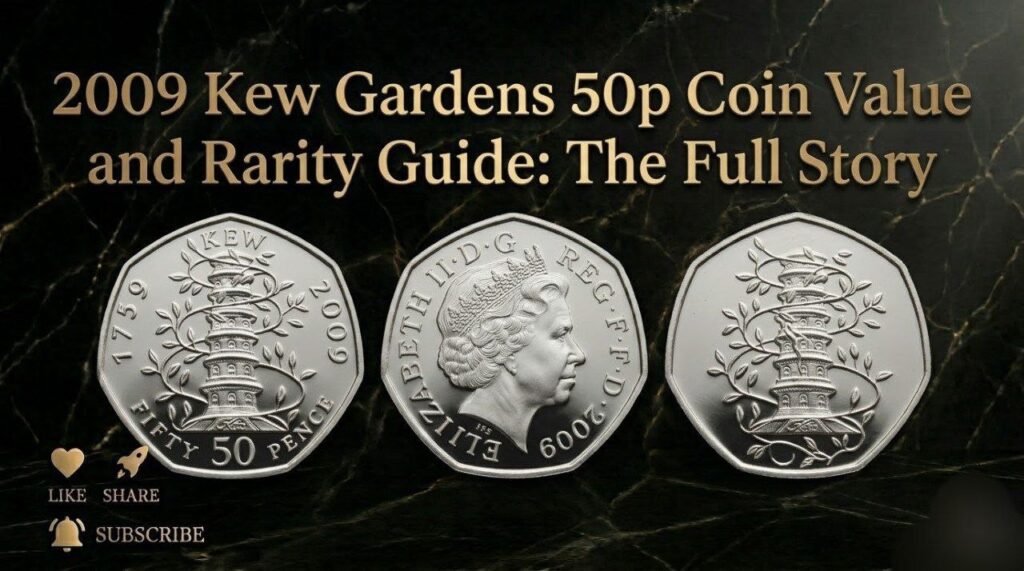
The back of the coin features the iconic Great Pagoda, a structure built in 1762 at Kew Gardens.
- The Vine: You will notice a lush, leafy vine climbing up the Pagoda. This represents the growth and botanical heritage of the gardens.
- The Dates: On the left, it says 1759 (the year the gardens were founded) and on the right, 2009 (the year of the coin’s release).
- The Designer: This masterpiece was created by Christopher Le Brun, a renowned artist who captured the elegance of the structure perfectly.
The Obverse (The Queen’s Side)
The front features the Fourth Definitive Portrait of Queen Elizabeth II.
- The Artist: This portrait was designed by Ian Rank-Broadley.
- The Inscription: You will see the Latin text “ELIZABETH II · D · G · REG · F · D · 2009”. This stands for Dei Gratia Regina Fidei Defensor, meaning “By the Grace of God, Queen, Defender of the Faith.”
Technical Specifications: Weight, Size, and Shape
To ensure your specimen is genuine, the 2009 Kew Gardens 50p Coin Value and Rarity Guide recommends checking its physical properties against official standards provided by the Check Your Change resource.
| Feature | Specification |
| Shape | Equilateral Curve Heptagon (7 Sides) |
| Weight | Exactly 8.00 Grams |
| Diameter | 27.30 mm |
| Thickness | 1.78 mm |
| Metal Composition | 75% Copper, 25% Nickel (Cupro-nickel) |
Why Seven Sides?
The 50p coin is a Heptagon for a very scientific reason. In the late 1960s, during Decimalization, Britain needed a coin that was easily distinguishable from round coins by touch. The curved heptagon shape allows the coin to have a constant width, meaning it can roll and function perfectly in vending machines just like a circular coin.
The Longevity: How Long has it been in Circulation?
Launched in October 2009, this coin was intended to stay in circulation for decades. However, because collectors realized its rarity almost immediately, most were pulled out of circulation and kept in private collections. While it technically remains legal tender, finding one in your grocery change in 2026 is nearly impossible, as noted in our 2009 Kew Gardens 50p Coin Value and Rarity Guide.
The Royal Mint Re-issue (2019)
It is important to note that in 2019, the Royal Mint released a “re-issue” version to celebrate 50 years of the 50p coin. While the 2019 version is also collectable, it was never intended for general circulation. The original 2009 version remains the most valuable due to its organic scarcity in the wild.
How to Spot a Fake Kew Gardens 50p
Because of its high value, many counterfeits have entered the market, especially on platforms like eBay. Here is how to identify a real one according to the 2009 Kew Gardens 50p Coin Value and Rarity Guide:
- The “KEW” Text: On genuine coins, the word “KEW” is sharp and clear. On fakes, it often looks bloated.
- The Queen’s Portrait: On a real coin, the detail in the Queen’s hair is very fine.
- The Frosted Finish: Original Proof versions have a distinct frosted finish on the Pagoda against a mirror-like background.
The 1969 Connection
As we discussed in our previous deep dive into the 1969 50p Coin History, the 50p denomination was a gamble for the UK. The success of coins like the Kew Gardens edition proves that the 50p has become the most beloved canvas for British art and history.
The Market Value: What is it Worth Today?
This is what every reader wants to know. Based on recent data from auction houses like Spink & Son and verified sales, here is the price breakdown for 2026:
- Circulated Condition: If you find one that is slightly worn, it typically sells for £150 to £180.
- Excellent (Uncirculated) Condition: A clean, shiny version can easily fetch £230 to £280.
- Gold Proof Version: For the elite collectors, the Gold Proof version of this coin has been known to sell for over £5,000 at specialized auctions.
Conclusion:
This 2009 Kew Gardens 50p Coin Value and Rarity Guide proves that history is literally in the palm of your hands. Whether you are a seasoned collector or a casual enthusiast, keeping an eye on your change is always worth it.
For more rare coin checklists and the latest market updates, stay tuned to mrriaz.com