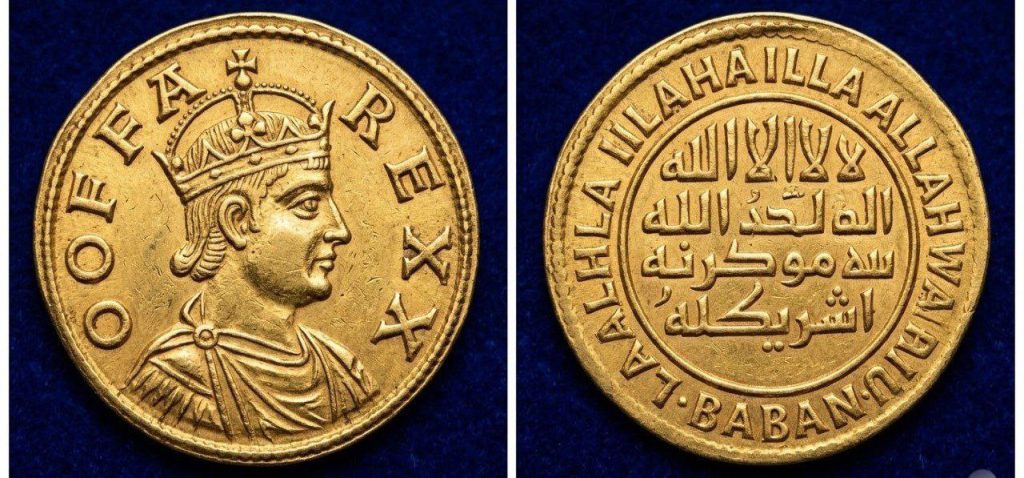
The King Offa Gold Dinar Secret is a ghost that has haunted British history for over a millennium. Imagine a time when the cross and the crescent were locked in a titanic struggle, yet in the heart of England, a Christian King was minting a coin that bore the holiest declaration of Islam. This is not a myth; it is the King Offa Gold Dinar Secret, an archaeological enigma that challenges everything we thought we knew about the Dark Ages.
The Discovery that Shook the Vatican
The King Offa Gold Dinar Secret first came to light in a way that sounds like a Hollywood thriller. In the 19th century, a gold coin was found in Rome, of all places. It wasn’t a Roman coin, nor was it a standard Anglo-Saxon penny. It was a perfect gold dinar, heavy and pure. But as experts cleaned the ancient grime away, the truth revealed its shocking face: Islamic Kufic calligraphy surrounding the name of an English King.
Why would the Pope’s city be hiding such a treasure? Some say it was part of a secret tribute, a “Peter’s Pence” payment sent by Offa himself. But the fact that the Church accepted a coin declaring “There is no god but Allah” adds a layer of scandal to this story that most historians are afraid to discuss. According to records at the British Museum, this specimen remains one of the most controversial pieces in their entire collection.
Who Was the Man Behind the King Offa Gold Dinar Secret?
To unravel the mystery, we must look at Offa of Mercia—a man so powerful that even Charlemagne treated him as an equal. Offa was a builder of dykes and a destroyer of enemies, but the King Offa Gold Dinar Secret suggests he was also a master of the “Great Game” of ancient economics. He knew that the Islamic Caliphate held the world’s gold.
The evidence suggests that Offa didn’t just want to rule England; he wanted to dominate the global markets of the 8th century. By minting this specific coin, he was effectively creating a “global passport” for his wealth. He was telling the merchants of Baghdad and Cordoba, “My money is as good as yours.” This bold economic move is documented in the History Archives of Early England.
The Controversial Inscription: A Secret Faith?
The most explosive part of the King Offa Gold Dinar Secret is the Kufic script itself. It isn’t just random letters; it is the Shahada. For centuries, people have whispered, asking if Offa had secretly embraced Islam. Could the King of Mercia have been a closet Muslim?
While this theory provides fuel for debate, a closer look at the coin reveals a clumsy hand. The English engravers made mistakes in the Arabic. This tells us that the craftsmen were likely copying a design they didn’t understand. To them, the Kalima was just a “prestige pattern” that meant “This is high-value gold.” But the mystery remains: did Offa know what it said? This is the heart of the King Offa Gold Dinar Secret.
Hidden Evidence and Archaeological Cover-ups
Many believe that more specimens exist but are being kept in private, “off-the-books” collections. The King Offa Gold Dinar Secret is so controversial because it breaks the narrative of a purely “Christian Europe” during the Middle Ages.
Archaeologists have found traces of Islamic silver across Northern Europe, but this is the only one where a Western King’s name is physically struck onto an Islamic design. When we investigate the King Offa Gold Dinar Secret, we find a trail of trade routes that connect the cold shores of Britain to the burning deserts of the Abbasid Empire. This connection is what this research proves—a world far more connected than our history books allow.
The Value of the Secret: Why Collectors Kill for It
In the world of numismatics, this discovery is the ultimate prize. Because only a few exist, the King Offa Gold Dinar Secret has become a symbol of ultimate rarity. A single coin could buy a mansion, but it is worth more than money; it is a piece of a forgotten timeline.
If you ever find a coin that looks like a gold dinar but has Latin letters buried in the Arabic, you have found the King Offa Gold Dinar Secret. But beware—authenticating it requires expert lab results, as the market is flooded with fakes.
Decoding the Lab Results: What Does the Gold Tell Us?
Scientific analysis reveals that the gold is 97% pure—matching the standards of the Caliph Al-Mansur. This part of the King Offa Gold Dinar Secret proves that Offa didn’t just copy the look; he copied the value. He was importing high-grade gold to strike these coins, likely through intermediaries in France or Italy.
The research also reveals that the dies used were made by high-level artisans. Every stroke on the coin was calculated. This wasn’t a mistake; it was a deliberate, high-stakes political move that defined Offa’s reign. The King Offa Gold Dinar Secret is the fingerprint of a genius.
Conclusion: The Secret That Won’t Die
This history continues to challenge our perception of the past. It is a bridge between two worlds that we were told were enemies. The King Offa Gold Dinar Secret tells us that power, gold, and trade have always ignored the boundaries of religion and race.
As long as the coin sits in the museum, it will remain a silent witness to a truth that was almost buried. The King Offa Gold Dinar Secret is not just a coin; it is a warning that history is never as simple as it seems.
For the full, unedited archaeological report and exclusive images of the King Offa Gold Dinar Secret, visit our secure archive at MRRIAZ.COM.