Rare Cunobeline Wheat Ear Coin Value & History is a subject that connects the silent gold era of 50 BC to the literate and powerful kingdom of the Catuvellauni tribe. It marks the exact moment when British kings decided to put their names on their money.
Before we dive into the fascinating story of King Cunobeline, you might want to explore our complete collection of ancient treasures. From the legendary 50 BC gold pieces to the most sought-after Roman era finds, we have mapped them all out for you. [Click here to Explore our Rare Coin Category] to discover more hidden fortunes and updated market values for 2026.
The Evolution of British Sovereignty
To understand why this coin exists, we must first look at the landscape of 50 BC. For over half a century, the Catuvellauni tribe relied on a gold currency that was powerful but silent.
These early gold staters were anepigraphic, meaning they bore no names, no titles, and no locations. They were the currency of a tribal world that moved by tradition, not by bureaucracy. According to historical records at The British Museum, these coins represent a pre-literate society where symbols spoke louder than words.
The king who ruled during the 50 BC era remains an enigma. While he controlled the gold mines and the warrior elite, he lived in a Britain that was still isolated. His coins lasted for nearly 60 years, serving as the primary medium of exchange.
However, by the turn of the millennium, the “Silent Era” of British coinage began to fail. The lack of a king’s name on the currency became a disadvantage. The British tribes needed a leader who could speak the language of power that the Romans understood. You can explore this further in our 50 BC Gold Stater Price Guide.
The Transitional Years
The shift that led to the Rare Cunobeline Wheat Ear Coin Value & History began with a visionary ruler named Tasciovanus. He was the father of Cunobeline and the first British king to break the tradition of silence.
Around 20 BC, Tasciovanus began to strike his name into his coins. This was a radical move. He wasn’t just a tribal chieftain anymore; he was a sovereign. He established a dynasty that would eventually bridge the gap between Celtic tradition and Roman sophistication. You can read more in our article on Tasciovanus Legacy and Coins.
Tasciovanus ruled for approximately 30 years. During this time, the old 50 BC gold staters were slowly phased out or melted down. The reason for this transition was purely political. A coin with a name was a guarantee of weight, purity, and value.
As trade with Rome increased—involving grain, hunting dogs, and iron—the Romans demanded to know whose “mark” was on the metal. This political and economic pressure is exactly why the nameless coins had to die out. Data from the Portable Antiquities Scheme shows that these transitional coins are often found in trade-heavy regions.
The Ascension of King Cunobeline
The Rare Cunobeline Wheat Ear Coin Value & History officially begins around 10 AD. This was the year Cunobeline took the throne following his father, Tasciovanus. The relationship between the two was one of direct succession—father to son.
But Cunobeline was even more ambitious than his father. Upon his ascension, he moved the royal capital to Camulodunum (modern-day Colchester). This was a strategically superior location for controlling trade with Europe.
Cunobeline did not just continue his father’s coinage; he revolutionized it. He understood that to be respected by the Roman Emperors, he had to act like a Roman client-king. He minted his coins in gold, silver, and bronze.
His reign lasted for 30 glorious years, a period called the “Golden Age” of the Catuvellauni. He was so successful that he earned the title Britannorum Rex (King of the Britons), as detailed by Colchester Archaeology Trust.
Decoding the Symbols
One of the most vital parts of the Rare Cunobeline Wheat Ear Coin Value & History is the specific iconography used on the coin. Why was it necessary to change the design so drastically from the 50 BC era?
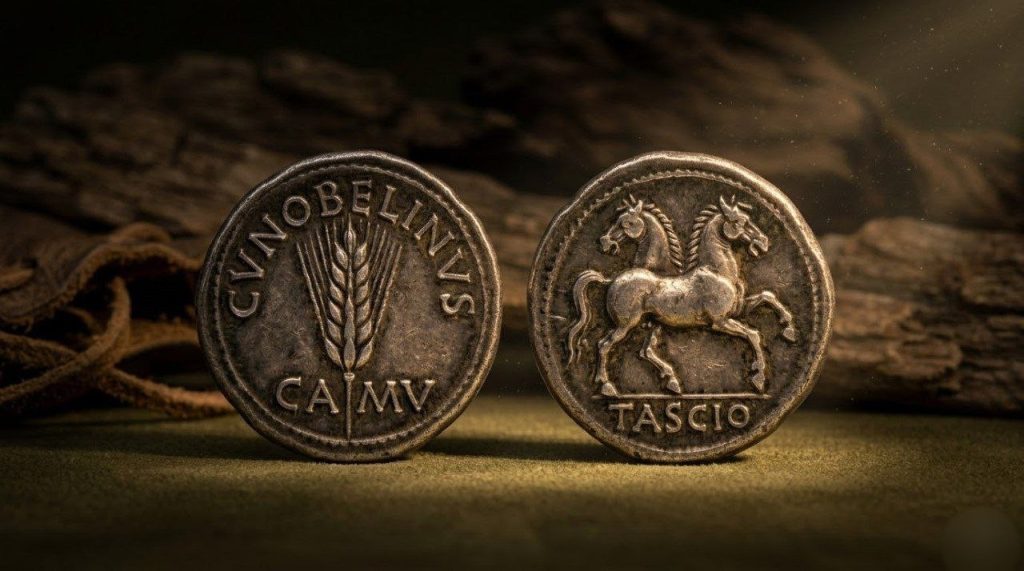
On the front of these coins, you see a meticulously engraved wheat ear. This was a direct signal of Britain’s agricultural export power. Beneath or beside it, the letters ‘CAMV’ appear.
This was a revolutionary addition. By naming the mint location (Camulodunum), Cunobeline was proving that he controlled a centralized city. The previous kings did not need to name their cities because their power was nomadic. Cunobeline’s power was urban and organized.
The back of the coin often features a horse—sometimes single-headed, sometimes double-headed—along with the word ‘CVNO’. This was the king’s signature. It was no longer enough to have a horse on a coin; it had to be Cunobeline’s horse.
The horse was a symbol of the warrior elite. By adding his name, he tied the military might of the tribe directly to his personal authority. These words were necessary to establish a legal tender. This level of detail is why these pieces are so prominent in our British Coin Value Index 2026.
The Final Legacy of the Catuvellauni
The era of the Rare Cunobeline Wheat Ear Coin Value & History came to an end shortly after the king’s death in 40 AD. His sons, Caratacus and Togodumnus, lacked their father’s diplomatic finesse.
Their aggressive stance toward Rome provided Emperor Claudius with the perfect pretext for the Roman invasion of Britain in 43 AD. Within years, the Roman authorities began withdrawing Cunobeline’s coins.
They replaced them with Roman Denarii. This is why these coins are so rare today. They represent the final three decades of an independent Britain. They are the last artifacts of a lost empire that existed 60 years after the gold era of 50 BC.
Finding a Cunobeline coin is like finding a piece of the soul of ancient Britain. Experts at Colchester Museums confirm that these coins are among the most significant finds for understanding pre-Roman life.
Current Market Value Guide (2026)
The following table provides the current market valuation for the Rare Cunobeline Wheat Ear Coin Value & History based on 2026 auction trends.
| Condition Grade | Estimated Value (GBP) | Estimated Value (USD) |
| Fine (F) | £450 – £600 | $570 – $760 |
| Very Fine (VF) | £950 – £1,450 | $1,200 – $1,850 |
| Extremely Fine (EF) | £1,800 – £2,800+ | $2,300 – $3,550+ |
| Choice Mint State | £3,500 – £5,000 | $4,450 – $6,350 |
Conclusion
The Rare Cunobeline Wheat Ear Coin Value & History stands as a testament to a king who understood power. By transitioning from silent gold to a named currency, he secured his place in history. Today, these coins remain the most sought-after treasures for any serious collector.