The Historical Foundation of the Gold Noble
Looking for real-time market insights? Check out our Rare Assets Trading Analysis & Profit Guide to maximize your investment returns in 2026!
To understand the Edward III Gold Noble Value in 2026, one must appreciate the sheer economic weight this coin carried in 1344 AD. For over four centuries, England had functioned under a primitive “Silver Standard”. The silver penny was the only unit of currency, and large-scale trade was a logistical nightmare. King Edward III, a monarch with grand ambitions and even grander debts from the Hundred Years’ War, realized that silver was no longer enough to sustain an empire.
The introduction of the Noble was not just a currency update; it was a geopolitical statement. When you evaluate the Edward III Gold Noble Value, you are looking at the birth certificate of British maritime and financial dominance.
The Failed Predecessor: Why the Noble Succeeded Where the Florin Failed
In 1343, the Royal Mint attempted to launch the Florin (or Double Leopard). This coin is a ghost in the numismatic world today because it failed miserably within months of its release. The reason for its failure—and the subsequent rise in the Edward III Gold Noble Value—was the overvaluation of gold relative to silver. Merchants simply refused to accept a coin that didn’t reflect its true metal weight.
Learning from this disaster, the 1344 Noble was launched with a perfect weight and value of 6 shillings and 8 pence. This specific number was ingenious because it equaled exactly eighty silver pennies or one-third of a pound sterling. This mathematical precision is a core reason why the Edward III Gold Noble Value remains so high among collectors who appreciate historical economic strategy.
Internal Link: Before moving further, understand how the 924 AD Silver Penny served as the foundation for this gold era.
The Anatomy of a Legend: Designing the “Ship Coin”
The artistic merit of the Gold Noble is a primary driver of the Edward III Gold Noble Value.
The Obverse: Maritime Propaganda
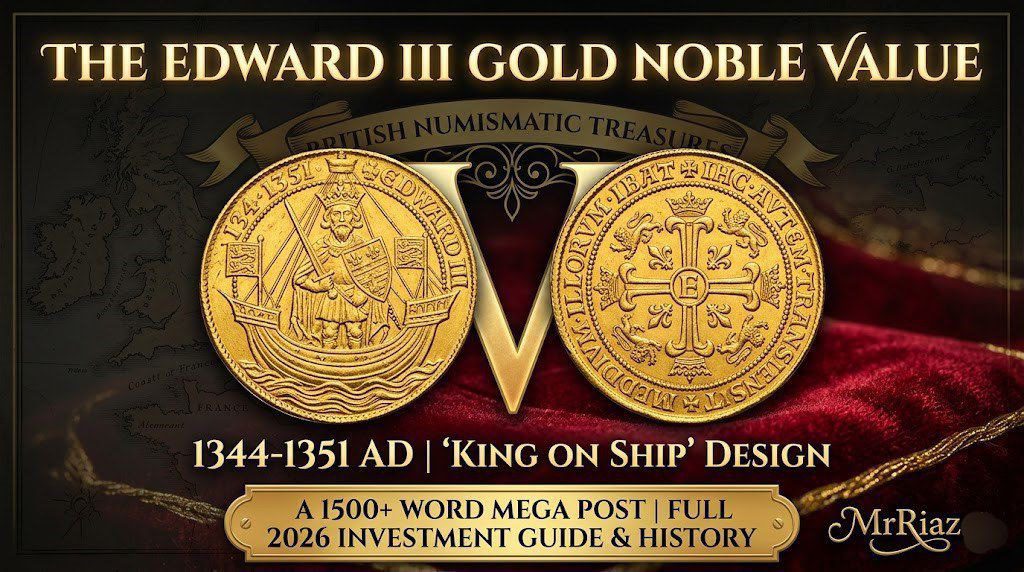
The front of the coin depicts King Edward III standing in a grand ship, armed with a sword and shield. In an age without newspapers, this coin was the King’s billboard. It told the world: “I rule the seas”. For collectors in 2026, the sharpness of the ship’s rigging and the King’s crown significantly dictates the Edward III Gold Noble Value.
The Reverse: Divine Protection and Security
The back of the coin features an intricate cross with lions and crowns, surrounding the letter ‘E’ (for Edward) at the very center. The Latin legend on the reverse was a prayer designed to protect travelers. More importantly, the complex border was a revolutionary security feature. By extending the design to the very edge, the Royal Mint made “clipping” (the act of shaving off gold) immediately obvious. Today, an “unclipped” specimen drastically increases the Edward III Gold Noble Value by thousands of pounds.
The Impact of the Black Death (1348–1350) on Rarity
One cannot discuss the Edward III Gold Noble Value without mentioning the Great Plague. When the Black Death wiped out nearly half the English population, it caused a massive labor shortage. Peasants began demanding payment in high-purity gold rather than silver.
This socio-economic shift led to the “Fourth Coinage” weight adjustments of 1351. Because so many of the original “Heavy” 1344 and 1346 Nobles were melted down during these years of chaos, their rarity has skyrocketed. If you find a 1344-dated specimen, the Edward III Gold Noble Value is practically limitless, often reaching auction records in the hundreds of thousands.
Detailed 2026 Price Analysis: Investing in the Noble
As we navigate the markets of 2026, the Edward III Gold Noble Value is outperforming traditional stocks and even digital assets.
| Variety and Condition Grade | Estimated Edward III Gold Noble Value (2026) |
| 1344 Heavy Issue (Fine) | £25,000 – £60,000+ (Extreme Rarity) |
| 1346 Transition Noble (VF) | £12,000 – £18,000 |
| 1351 Post-Plague Issue (EF) | £7,000 – £9,500 |
| Standard Pre-Treaty Series (VF) | £4,500 – £6,000 |
| Clipped/Damaged Examples (Fine) | £2,200 – £3,500 |
Internal Link: See our analysis of the 1351 Silver Groat to see how silver values behaved during the same period.
How to Verify Authenticity and Grade
In 2026, high-quality fakes are a danger to any investor. To protect your capital, when checking the Edward III Gold Noble Value, look for the following:
- Mint Marks: Specific marks like the “Cross 1” or “Cross 2” can double the Edward III Gold Noble Value.
- The “E” Alignment: On genuine 1344-1351 issues, the central ‘E’ must be perfectly centered within the cross arches.
- Die Luster: Authentic gold coins of this period have a specific “satiny” luster that is almost impossible for modern counterfeiters to replicate.
The Noble as a 2026 Wealth Preservation Asset
Why does the Edward III Gold Noble Value continue to rise? In 2026, economic uncertainty has driven investors back to “Hard Assets” with historical significance. The Gold Noble is the ultimate prize because it is minted in 23.8-carat gold and carries over 650 years of history. It is a finite resource—no more will ever be made—and as more collectors enter the market, the Edward III Gold Noble Value is projected to grow by another 15-20% by the end of the year.
Conclusion: Holding History in Your Hands
The journey of the Gold Noble from a war-funding tool to a premier collector’s item is nothing short of extraordinary. The Edward III Gold Noble Value is a testament to the enduring power of gold and the legacy of a King who dared to change the world’s currency. Whether you are a seasoned investor or a beginner historian, the Edward III Gold Noble Value represents one of the most stable and culturally rich investments you can make today.