[Click Here to Visit Our Rare Assets & Trading Analysis Hub for Daily Price Updates]
Breaking the 400-Year Monetary Silence
In the high-stakes investment world of 2026, historical “Hard Assets” like the Edward III Silver Groat have emerged as a premier choice for hedging against inflation. While the King Athelstan Silver Penny established the first unified currency in 924 AD, the arrival of the Edward III Silver Groat in 1351 broke a staggering 427-year-long stagnation in British coinage. This guide is a definitive deep dive into the coin that changed the scale of British wealth forever.
Chapter 1: The Dark Ages of the Penny (924 AD – 1351 AD)
To understand why the Edward III Silver Groat was such a shock to the system, one must analyze the four centuries of economic “silence” that preceded it.
- The Feudal Stagnation: For over 400 years, the English economy was almost entirely localized, and the single Silver Penny provided exactly the right amount of purchasing power for daily survival.
- The Mastery of the “Cut” System: Instead of minting smaller coins, people physically cut the King Athelstan Silver Penny into halves or quarters to create change.
- A Lack of Innovation: For four centuries, the Crown saw no need for larger denominations because international trade was limited to small-scale exchanges.
- The Trust Factor: The silver penny was so trusted that any attempt to change it was met with public resistance until the crisis of the 14th century.
- The Long Gap: This 427-year period remains one of the longest stretches in history where a major nation relied on a single denomination of coin.
- o understand the legal transition of these coins, you can explore the covering this 400-year gap.“
Chapter 2: The 14th Century Catalyst – Why 1351 AD?
The year 1351 was not a random choice; the Edward III Silver Groat was born out of two massive global crises.
- The Black Death Crisis: The plague (1348) decimated the population, leading to a labor shortage and a massive rise in wages.
- The Hundred Years’ War: King Edward III needed a more efficient way to pay his massive armies fighting in France.
- Logistical Efficiency: Paying a soldier or a builder in thousands of tiny pennies became a nightmare; the Edward III Silver Groat, being worth four pennies, solved this instantly.
- Inflationary Pressure: As prices rose, the tiny penny could no longer handle larger commercial transactions, forcing the hand of the Royal Mint.
- Economic Evolution: This era marked the transition from a simple agrarian economy to one fueled by military expansion and international trade.
Chapter 3: Anatomy of a Masterpiece – Identifying the 1351 Groat
The Edward III Silver Groat was a revolution in medieval security and art.
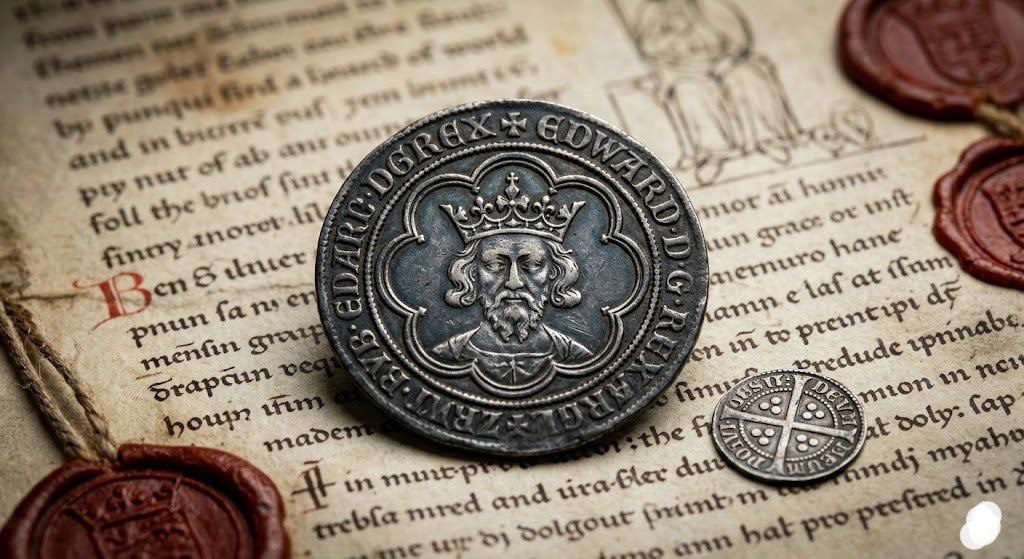
- The Tressure of Nine Arches: The King’s portrait on the Edward III Silver Groat was placed inside a decorative border of nine arches to prevent illegal edge clipping.
- The Long Cross Defense: On the reverse, the cross extended to the very edge of the coin, making it obvious if silver had been shaved off.
- The Double Legend: Unlike the penny, the Edward III Silver Groat carried two circles of text for added authenticity and more space for royal titles.
- The Religious Motto: The outer legend carried the motto: “Posui Deum Adiutorem Meum” (I have made God my helper).
- Obverse Portraiture: The crowned head of Edward III within the arches became a standard for high-value silver coinage for years to come.
Chapter 4: Production Secrets of the London Mint
Every Edward III Silver Groat was a product of intense manual labor at the Tower of London.
- Hand-Hammered Excellence: These coins were struck between two iron dies, making each one a unique historical fingerprint.
- Silver Purity: The Edward III Silver Groat was made of high-grade sterling silver to maintain international trust during the war years.
- The Role of the Moneyer: High-status officials oversaw the production of the Edward III Silver Groat to ensure every coin met the King’s precise weight standards.
- Mass Production vs. Survival: Millions were minted to fund the French campaigns, yet very few have survived in “Extremely Fine” condition in 2026.
- Die Variations: Due to the hand-made nature of the dies, collectors often look for tiny variations in the lettering and portrait.
Chapter 5: Investment Analysis and 2026 Market Value
In 2026, the Edward III Silver Groat is considered a “Blue Chip” historical asset.
- Scarcity and Demand: High-grade specimens from the initial 1351 production of the Edward III Silver Groat are incredibly rare and highly sought after.
- Current Valuation: In 2026, a “Very Fine” (VF) Edward III Silver Groat can command prices between £1,000 and £3,500 at premier auctions.
- Historical Performance: Medieval silver assets have consistently outperformed traditional inflation-linked bonds over the last decade.
- Liquidity: The Edward III Silver Groat is highly liquid in the global numismatic market, often selling quickly due to its historical importance.
- Condition Ranking: “Full Flans” and “Sharp Portraits” are the primary drivers of premium pricing in 2026.
Chapter 6: Preservation and Professional Authentication
Managing a 650-year-old asset requires adherence to strict professional standards.
- The Patina Factor: The dark, natural toning on an Edward III Silver Groat is its “certificate of age” and should never be removed.
- The Danger of Cleaning: Chemical cleaning can instantly reduce the market value of an Edward III Silver Groat by 80%.
- Expert Certification: Ensure your asset is graded by a reputable service like the NGC or verified by the BNTA.
- Storage Requirements: Keep your Edward III Silver Groat in an acid-free environment to prevent further oxidation or damage.
- Handling: Always handle these coins by the edges using cotton gloves to prevent skin oils from causing corrosion.
Chapter 7: The Bridge to the Gold Era
The Edward III Silver Groat was the bridge between a simple silver economy and the glorious gold era that followed.
- International Power: While the Groat served domestic trade, the King realized international trade required something even more valuable: Gold.
- Transition to the Noble: This led to the introduction of the Gold Noble, which became the currency of the elite and large international merchants.
- Workhorse of the Economy: Despite the gold coins, the Edward III Silver Groat remained the primary tool for paying wages and funding the common soldier.
- Legacy: Owning an Edward III Silver Groat in 2026 is owning a piece of the engine that built the British Empire.
- Historical Conclusion: The Groat effectively ended the medieval “Age of the Penny” and launched Britain into the modern era of complex currency.