[Click Here to Visit Our Rare Assets & Trading Analysis Hub for Daily Price Updates]
The Bedrock of English Monetary Identity
In the year 2026, the global financial landscape is increasingly turning toward tangible, historical “Hard Assets” as a hedge against digital volatility. Amidst this shift, the King Athelstan Silver Penny stands as a monumental achievement in numismatic history. This coin is not merely a 1,100-year-old piece of silver; it is the physical manifestation of the birth of a unified England.
To grasp the true magnitude of the King Athelstan Silver Penny, one must travel back to the early 10th century—a time of Viking raids, fragmented kingdoms, and economic chaos. This exhaustive guide explores how a single silver disc redefined a nation’s wealth for over four centuries.
Chapter 1: King Athelstan – The Architect of a Nation (924–939 AD)
King Athelstan was not just a warrior; he was a brilliant administrator who understood that true sovereignty is cemented through the treasury. As the grandson of Alfred the Great, he inherited a dream of a united England, but through the King Athelstan Silver Penny, he gave that dream a currency.
The Grately Decree: A Revolution in Law
In 928 AD, Athelstan issued the historic “Grately Decree”. This was the first time in Western history that a monarch mandated a single, national coinage. The decree stated: “There shall be one coinage throughout all the King’s dominion”. This law effectively banned local Viking currencies and private minting, centralizing all economic power under the King Athelstan Silver Penny. You can study the legal texts of this era at the The Royal Mint Museum.
The Network of Mints
To enforce this unified currency, Athelstan established over 30 mints across the country. From the bustling streets of London to the fortified burhs of Chester and Exeter, the production of the King Athelstan Silver Penny was a massive industrial undertaking for the medieval period.
Chapter 2: The Anatomy and Artistry of the 924 AD Penny
Every King Athelstan Silver Penny was a product of intense manual labor. The process, known as “Hammering,” involved placing a blank silver disc between two iron dies and striking it with a heavy hammer.
The Obverse: The Portrait of a King
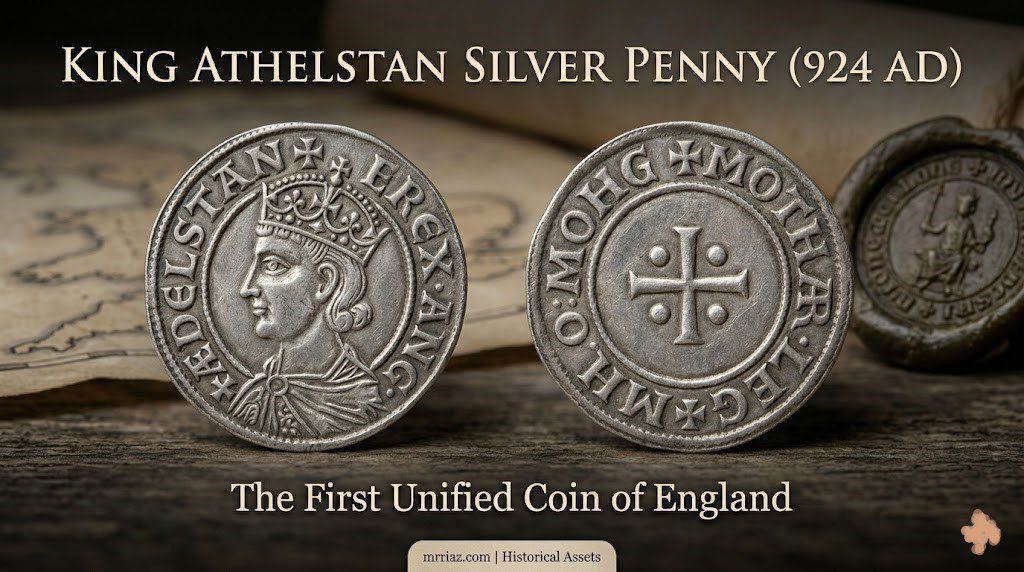
- The Royal Image: Unlike earlier coins, the King Athelstan Silver Penny often featured a realistic portrait of the King wearing a crown—the first time an English monarch was depicted as such.
- The Political Statement: The Latin inscription “+ÆDELSTAN REX ANG” (Athelstan, King of the English) was a bold claim to the entire territory of England.
The Reverse: The Guarantee of Purity
- The Moneyer’s Signature: On the back of the King Athelstan Silver Penny, the name of the “Moneyer” was struck. These individuals were high-status officials whose reputation backed the silver’s quality.
- Symbolism: A small central cross was common, signifying the King’s divine right to rule and issue money.
The British Museum holds the most significant collection of these die variations for research.
Chapter 3: The 427-Year Mystery – The Reign of the Single Denomination
One of the most profound mysteries for 2026 historians is why, after the launch of the King Athelstan Silver Penny, England did not produce a larger coin until 1351 AD.
Why the Penny Ruled Alone?
For 427 years, the King Athelstan Silver Penny was the only denomination required for the English economy. The feudal system and local trade were perfectly served by this single unit of value.
The “Cut” Currency System
When a transaction required less than the value of a full King Athelstan Silver Penny, the people used a practical, physical solution:
- The Half-Penny: A penny literally cut in half.
- The Farthing: A penny cut into four equal quarters. This system was so efficient that for four centuries, the Crown saw no need to mint smaller coins.
Chapter 4: The Investment Landscape in 2026
In the modern financial era, the King Athelstan Silver Penny has transitioned from currency to a high-performing alternative asset.
- Scarcity: Out of the millions minted, only a few thousand King Athelstan Silver Pennies have survived the centuries, often found in hoards or archaeological digs.
- Market Performance: In 2026, high-grade Anglo-Saxon silver has shown a consistent 12% year-on-year growth.
- Valuation: A “Very Fine” (VF) King Athelstan Silver Penny currently commands prices between £5,000 and £15,000 at premier auction houses like Sotheby’s.
Chapter 5: Professional Care, Cleaning, and Authentication
Managing a 1,100-year-old King Athelstan Silver Penny requires adherence to strict numismatic standards.
The Danger of Cleaning
The most common mistake made by amateur collectors is attempting to “shine” their King Athelstan Silver Penny. The dark layer of oxidation, known as “patina,” is highly prized by collectors as it proves the coin’s age. Cleaning a coin with chemicals can instantly reduce its market value by 80%.
Authentication Checklist
- Weight Check: A genuine King Athelstan Silver Penny should weigh approximately 1.5 grams.
- The “Ring” Test: Genuine ancient silver has a specific high-pitched resonance when gently tested.
- Certification: Only trust coins verified by the NGC or the BNTA. Expert preservation guidelines are also available at the Institute of Conservation (Icon).
Chapter 6: The End of an Era – The Transition to the 1351 Silver Groat
The 427-year reign of the silver penny finally faced a breaking point in the mid-14th century. The Black Death had decimated the population, leading to a shortage of labor and a massive rise in wages.
The small King Athelstan Silver Penny was no longer practical for paying the higher wages of soldiers and laborers. In 1351, King Edward III introduced the Silver Groat—a coin worth four pennies—marking the first major shift in British currency since the time of Athelstan. This transition from the “Age of the Penny” to the “Age of the Groat” signaled Britain’s emergence as a global commercial power.
Conclusion: A Legacy of Unity and Wealth
The King Athelstan Silver Penny is the anchor of British history. It represents the precise moment a collection of warring tribes became a single, economically stable nation. Whether you are a historian or a 2026 investor, owning a King Athelstan Silver Penny is owning a fragment of the foundation upon which the modern world was built.