Have you ever wondered if the face on your medieval penny is a real person? For nearly 500 years, the people of Britain were living under a massive royal deception. Before the introduction of British Royal Portrait Coins 1504, the monarchy used a “Mask” to represent power rather than reality. In this ultimate guide, we will uncover why the Kings of England hid their faces and how a single silver groat in 1504 changed the world of numismatics forever.
Part 1: The Philosophy of the “Invisible King” (924 AD – 1154 AD)
The journey of the English silver penny started with King Athelstan in 924 AD. While he was the first to officially unify England, his portrait was a total myth. But why? To understand British Royal Portrait Coins 1504, we must first understand the early medieval mindset. In the 10th century, a King was not seen as an ordinary man; he was a divine figurehead. If you look at the Athelstan Penny, you see a generic, symbolic sketch designed to represent “The Crown.” This was a deliberate choice. By keeping the King’s face generic, the monarchy ensured that the “Idea” of the King never aged, never fell ill, and never looked weak.
Part 2: The High Middle Ages and the Generic Mask (1154 AD – 1485 AD)
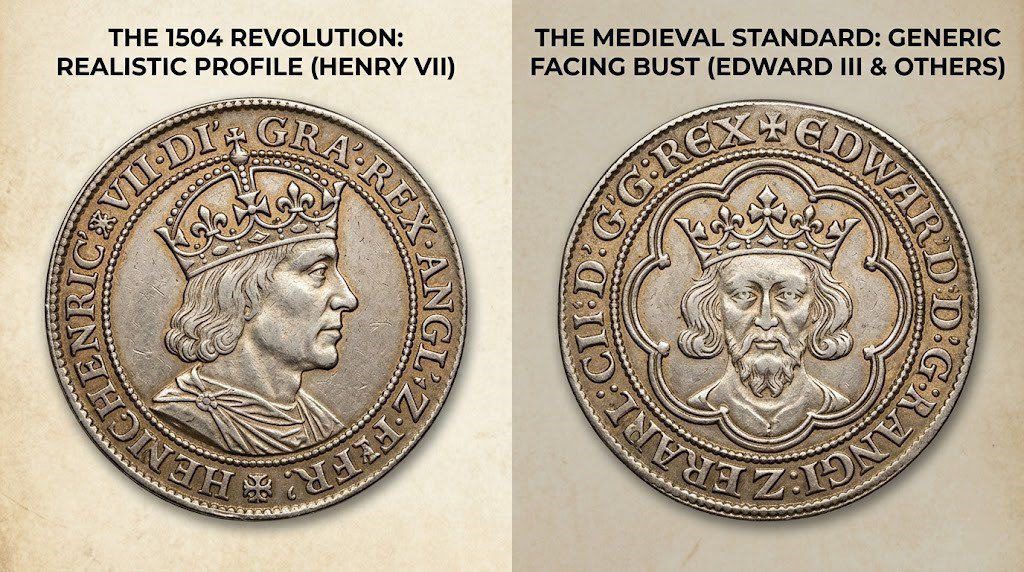
By the time of Edward III (1327-1377), the era of British Royal Portrait Coins 1504 was still centuries away. The English economy was booming, and new denominations like the Gold Noble and the Silver Groat were introduced. However, the portraits remained frozen in time. Historians call this “Generic Portraiture.” Even though Edward III reigned for 50 years and aged from a boy to an old man, his coins showed the same youthful, masked face. This was the “Royal Lie.” The coinage didn’t reflect the person; it reflected the office.
Part 3: The 1504 Revolution – Henry VII Breaks the Secret
The mystery finally collapsed in 1504. King Henry VII, the first Tudor King, decided to reveal the truth and modernize the English state. He hired the finest engravers to create the first-ever realistic British Royal Portrait Coins 1504. This “Profile Portrait” was a technological and artistic marvel. For the first time in 1,000 years, a coin featured a realistic nose, individual expression, and actual human likeness. This wasn’t just a new design; it was the birth of modern global currency as we know it today.
Part 4: Technical Analysis for Collectors
As a collector or hunter on MrRiaz.com, you need to know what makes the 1504 groat so special. Unlike previous coins that were “hammered” with crude dies, the 1504 issues showed a level of detail that was impossible to forge at the time. Look for the side-view portrait; if the King is facing you, it is likely the older, generic style.
Part 5: 2026 Market Valuation and Investment
Today, these transition pieces are the “Holy Grail” for UK Coin Hunters. In 2026, the market for British Royal Portrait Coins 1504 has reached an all-time high.
- Fine Condition: £800 – £1,200
- Very Fine (VF): £2,500 – £4,500
- Extremely Fine (EF): £10,000+
Part 6: Identification Checklist
If you are out in the fields and find a silver coin, follow this checklist on MrRiaz.com to see if you’ve found a British Royal Portrait Coins 1504:
- Check the Crown: Is it a simple three-pointed crown or a detailed Tudor crown?
- Observe the Eyes: Are they simple dots or do they have pupils?
- The Legend: Look for “HENRICUS” in clear Roman-influenced font.
Internal Resources for MrRiaz.com Readers:
- Identify Your Hammered Coins – MrRiaz.com Guide
- UK Finders Database Records – MrRiaz.com
- Rare Coin Price List 2026 – Exclusive on MrRiaz.com
Part 7: Conclusion – The Legacy of the Tudor Face
The 1504 revolution changed how we see history. It ended the 500-year “Royal Lie” and gave us the first true portraits. If you find one of these British Royal Portrait Coins 1504, you are holding the moment the Middle Ages ended. Stay tuned to MrRiaz.com for more deep dives.