The history of money is often a history of trust, but in the case of the British Royal Portrait Coins 1526, it is a history of betrayal. If you are a collector or a history enthusiast visiting MrRiaz.com, you are about to discover how one of the most powerful kings in English history, Henry VIII, turned his own currency into a tool for deception. In 2026, these coins are not just relics; they are high-value assets that tell a story of greed, war, and a scientific scam that took centuries to fully decode.
The Legacy of the Father: Henry VII and the Birth of Realism
To understand why the British Royal Portrait Coins 1526 are so controversial, we must first travel back to 1504. King Henry VII, the father of Henry VIII, was a man of stability. He ended the War of the Roses and brought peace to England. One of his greatest contributions to numismatics was the introduction of the first realistic royal portrait.
Before him, kings were shown as generic figures. Henry VII changed that, giving the people a true likeness of their monarch on a coin with 92.5% pure silver. This established a standard of honesty that the British people trusted for decades. However, when his son took over, that honesty was the first thing to be sacrificed.
1526: The Year the Trust Broke
By the time 1526 arrived, Henry VIII had been on the throne for 17 years. He was no longer the young, athletic prince his father left behind. He was a King obsessed with power, expensive wars against France and Scotland, and a lavish lifestyle that the royal treasury could no longer support.
The British Royal Portrait Coins 1526 were the result of a secret royal decree. Henry VIII realized that if he reduced the amount of precious metal in each coin but kept the face value the same, he could create “money out of thin air.” This was the beginning of the “Great Debasement,” a dark period where the Crown literally robbed its own citizens by devaluing the currency they used every day.
The Scientific Scam: How the Deception Worked
The British Royal Portrait Coins 1526 were masterpieces of deception. The King’s mint masters developed a process where they would melt down the pure silver coins of Henry VII and mix them with cheap, base copper.
To hide the truth, they used a technique called “pickling.” After the coin was struck from a copper-heavy alloy, it was dipped in a special acid that dissolved the copper on the surface, leaving a very thin layer of pure silver on the outside. When the coin left the mint, it looked like a shimmering, pure silver masterpiece. But as we know, lies don’t last forever.
The Legend of “Old Copper Nose”
This is the part of the story that makes the British Royal Portrait Coins 1526 so famous in 2026. Because the silver layer was so thin, it began to wear off as the coins were handled. Since the nose is the highest point on the King’s portrait, it was the first place the silver rubbed away.
Suddenly, the King’s silver face had a bright, reddish copper nose. The people realized they had been cheated. They began to call their King “Old Copper Nose” behind his back. This wasn’t just a nickname; it was a protest against the financial ruin the British Royal Portrait Coins 1526 had brought to the common man.
Technical Breakdown of the 1526 Coinage
For the serious collectors on MrRiaz.com, identifying a genuine British Royal Portrait Coins 1526 requires a deep understanding of its technical specifications.
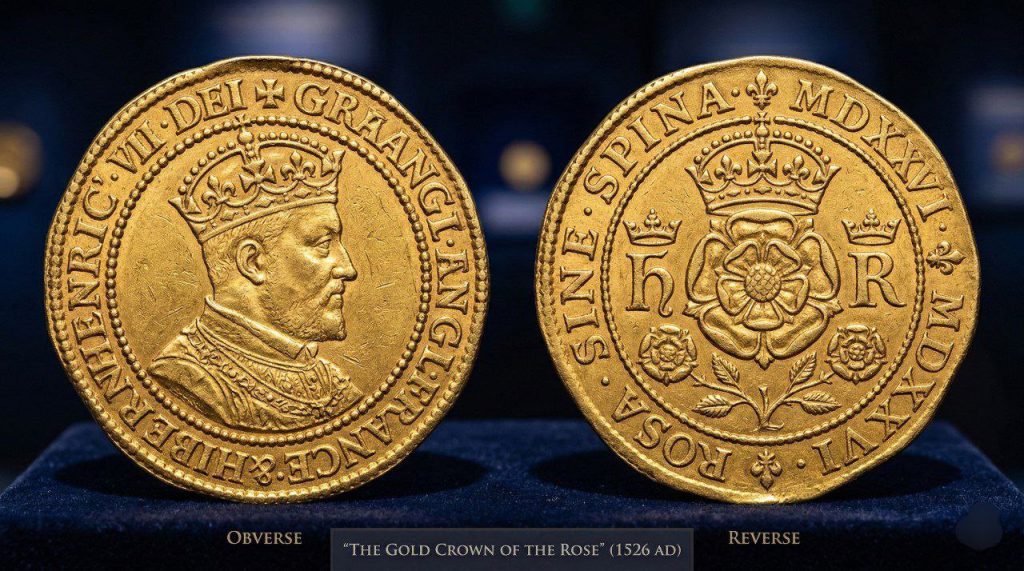
The Gold Crown of the Rose (1526)
This was the flagship coin of the 1526 reform. It was meant to compete with the French “Écu au soleil.”
- Obverse: A crowned shield with the arms of England and France.
- Reverse: A large Tudor rose on a cross.
- The Secret: While it looked like pure gold, its “fineness” was significantly lower than previous issues, making it a prime example of the 1526 deception.
The Silver Testoon (Shilling)
The Testoon is where the “Copper Nose” phenomenon is most visible. If you find a British Royal Portrait Coins 1526 Testoon today, you must check the weight. A debased coin will often weigh differently than a pure silver one, even if the size looks identical.
2026 Market Value Guide: The Secret Fortune
Why are we talking about these coins now? Because in 2026, the market for British Royal Portrait Coins 1526 has exploded. Investors are looking for tangible history, and nothing says “history” like a royal scandal.
| Condition of Coin | Estimated Value (GBP) | Estimated Value (PKR) |
| Poor / Heavily Worn | £950 – £1,800 | 332,500 – 630,000 PKR |
| Fine (F) | £3,000 – £5,500 | 1,050,000 – 1,925,000 PKR |
| Very Fine (VF) | £7,000 – £11,000 | 2,450,000 – 3,850,000 PKR |
| Extremely Fine (EF) | £15,000 – £30,000+ | 5,250,000 – 10,500,000+ PKR |
Note: These prices are for the British Royal Portrait Coins 1526 series only. Coins from the later years of the debasement (1544-1547) are often less valuable because they contain even more copper and are less rare.
The Secret Mint Marks of 1526
On MrRiaz.com, we don’t just give you the basics; we give you the secrets. To truly know if your British Royal Portrait Coins 1526 is worth a fortune, you must look for the “Mint Marks.”
- The Rose Mark: This indicates the coin was minted in London and is the most common.
- The Arrow Mark: This is much rarer and can increase the coin’s value by 30%.
- The Lis (Lily) Mark: Found on coins meant for international trade.
- The Double-Struck Error: Some British Royal Portrait Coins 1526 were accidentally struck twice in the mint. If you find a “double nose” or “ghosting” on the portrait, the value can skyrocket into the tens of thousands of pounds.
Identification and Authentication: Don’t Get Scammed Twice!
Just as Henry VIII scammed his people in 1526, modern forgers are trying to scam collectors today. To ensure your British Royal Portrait Coins 1526 is authentic, follow these steps:
1. The XRF Analysis
X-Ray Fluorescence (XRF) is the only way to be 100% sure. This machine can “see” through the silver layer to detect the copper core inside. If the copper content is too high or too low for the 1526 standards, it’s a fake.
2. The Sound Test (The Ring of Truth)
A pure silver coin has a high-pitched ring when tapped. A British Royal Portrait Coins 1526 will have a dull “thud” because of the copper. While this isn’t 100% scientific, it’s a great first step for any collector.
3. Consult MrRiaz.com Archives
We maintain a database of known genuine British Royal Portrait Coins 1526 images. Compare the letter spacing in the Latin inscriptions (HENRIC VIII DI GRA REX ANGL) with our high-resolution scans.
The Economic Impact: How the 1526 Scam Changed Britain
The British Royal Portrait Coins 1526 didn’t just hurt people’s pockets; they caused massive inflation. Prices of bread and meat doubled as merchants realized the coins were worth less. This led to social unrest and riots.
When you hold a British Royal Portrait Coins 1526, you are holding a piece of the very first economic crisis caused by government overspending. This is why these coins are so valuable to museums and private collectors—they are a physical lesson in economics.
Linking the Series: 1504 vs 1526
We have already discussed the British Royal Portrait Coins 1504 in our previous post. The 1504 coins represent the “Father’s Truth,” while the British Royal Portrait Coins 1526 represent the “Son’s Deception.” To have a complete Tudor collection, you must have both. One shows the rise of British art, and the other shows the fall of British integrity.
(Source for historical verification: British Museum Coin Department)
Conclusion: The Final Word on the 1526 Masterpiece
The British Royal Portrait Coins 1526 remain one of the most fascinating chapters in the history of the world. Henry VIII may have succeeded in funding his wars, but his reputation was forever stained by the red copper of his own coins.
For the modern collector, these coins are a bridge to a world of royalty, scandal, and secret fortunes. In 2026, the hunt for the “Copper Nose” is more intense than ever. Don’t be the one who misses out on a hidden fortune because you didn’t know what to look for.
Stay tuned to MrRiaz.com for our next deep dive into the coins of Edward VI, the boy king who had to clean up his father’s mess!