The Birth of a Medieval Icon
After the devastating Black Death swept through England between 1348 and 1350, the nation’s economy was left in ruins. Labor was scarce, wages were rising, and the old monetary system was struggling to keep up with the new reality of the 14th century. In response, King Edward III introduced a revolutionary coinage reform in 1351. Among these new coins was the 1351 Silver Half Groat, a masterpiece of medieval minting that would become the backbone of English trade.
In this deep-dive analysis on MrRiaz.com, we explore why the 1351 Silver Half Groat is more than just a piece of silver—it is a symbol of resilience and a high-growth asset in the 2026 rare coin market.
Historical Context: Why Was the 1351 Silver Half Groat Launched?
To understand the value of the 1351 Silver Half Groat, we must look at the “Fourth Coinage” period. Before 1351, the English currency mostly consisted of the tiny silver penny. However, as inflation hit post-plague England, a penny was no longer enough for daily transactions, yet a full 4-pence Groat was too large for many.
King Edward III strategically launched the 1351 Silver Half Groat to fill this “missing link” in the economy. Valued at exactly 2 pence, it provided the perfect balance for paying the newly increased daily wages of skilled laborers and merchants.
Internal Link Suggestion: [“The 1344 Gold Noble: England’s First Successful Gold Coin“]
Technical Specifications of the 1351 Silver Half Groat
For any serious collector on UK Coin Hunter, knowing the technical details is essential to spot a genuine piece:
- Ruler: King Edward III (1327–1377).
- Issue Date: 1351 (Pre-Treaty Period).
- Metal: .925 Sterling Silver.
- Denomination: Half Groat (2 Pence).
- Weight: Approximately 2.2 to 2.3 grams (though often worn in lower grades).
- Mint: Primarily London and York.
Design Breakdown: Obverse vs. Reverse
The 1351 Silver Half Groat is famous for its intricate gothic art.
The Obverse (Front Side)
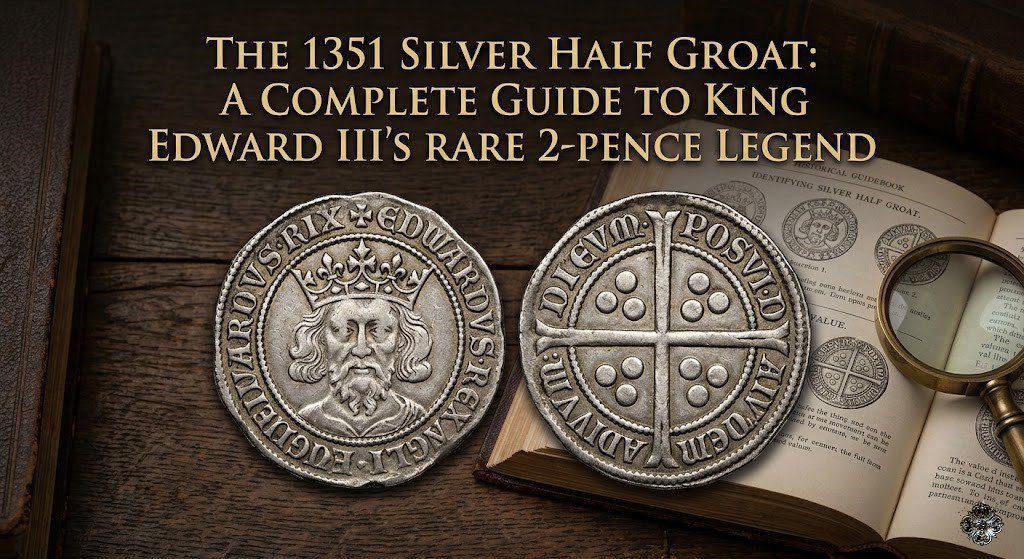
The front of the coin features a crowned, facing bust of King Edward III. What makes the 1351 Silver Half Groat stand out is the “Nine-Arched Tressure” surrounding the portrait. This ornate frame was designed to protect the king’s image from “clipping” (the illegal practice of shaving silver off the edges).
The Reverse (Back Side)
Flip the 1351 Silver Half Groat over, and you will see the iconic “Long Cross”. This cross extends to the very edge of the coin, dividing the reverse into four quarters. Inside each quarter are three small pellets, representing the Holy Trinity—a common theme in medieval English coinage.
How to Distinguish the Half Groat from the Full Groat?
Many beginners on UK Coin Hunter confuse the 1351 Silver Half Groat with the 4-pence Groat we discussed yesterday. Here is how to tell them apart:
- Size and Weight: The 1351 Silver Half Groat is noticeably smaller (approx. 22mm vs 27mm) and weighs exactly half of the full Groat.
- Shortened Legends: Because the coin was smaller, the Latin inscriptions had to be abbreviated. While the full Groat says “EDWARDVS D G REX ANGL Z FRANC D HYB,” the 1351 Silver Half Groat often cuts “France” or “Ireland” short to fit the circle.
- The Legend Style: Look for the specific “Pre-Treaty” lettering styles which are unique to the 1351-1361 period.
Investment Potential in 2026: Why Buy the 1351 Silver Half Groat?
As we track rare assets on MrRiaz.com, the 1351 Silver Half Groat has shown consistent growth. In the 2026 market, demand for mid-tier silver denominations from the 100 Years’ War era is at an all-time high.
- Scarcity: High-grade examples (EF or better) are significantly harder to find than full Groats because Half Groats were used more frequently in daily trade and suffered more wear and tear.
- Historical Value: As a “Plague Era” survivor, this coin appeals to history buffs and financial investors alike.
- Liquidity: Due to its manageable price point compared to gold nobles, the 1351 Silver Half Groat is a highly liquid asset in the UK and international markets.
Common Varieties and Mint Marks
Collectors should pay close attention to the mint marks on the 1351 Silver Half Groat. While the London mint is the most common, pieces from the York mint carry a significant premium due to their lower mintage numbers. Look for the “CIVITAS EBORACI” (York) or “CIVITAS LONDON” (London) inscriptions on the reverse.
Expert Advice: Always use a high-resolution magnifying glass to check for “over-struck” letters, which can double the value of your 1351 Silver Half Groat.
To verify the authenticity and see more historical records of King Edward III’s silver denominations, you can explore the British Museum’s Medieval Collection. This will help you understand how the 1351 Silver Half Groat stood out among other coins of that era.”
Conclusion: A Masterpiece for Your Portfolio
The 1351 Silver Half Groat is a testament to the economic genius of the medieval period. Whether you are a dedicated follower of UK Coin Hunter or a first-time investor visiting MrRiaz.com, this coin offers a unique blend of history, art, and financial stability.
Stay tuned to our daily series as we explore the 1361 Gold Treaty Noble next!